April 13, 2012

Fortnight for Freedom

On April 12, 2012, the U.S. Conference of Catholic Bishops' Ad Hoc Committee on Religious Liberty, chaired by Archbishop William E. Lori of Baltimore, MD, published a statement on religious liberty.  The complete statement is available on-line and in .pdf format at the following web address:

http://www.usccb.org/issues-and-action/religious-liberty/our-first-most-cherished-liberty.cfm

In the statement, the bishops made the following exhortation:

For Those of Us Who "Don't Work"

Apparently, the latest effrontery in the completely manufactured "War on Women" comes directly from the Democratic machine itself via the mouthpiece of Hilary Rosen, a liberal talking head on CNN, who astonishingly remarked this week that Ann Romney, wife of Republican presidential candidate Mitt Romney and stay-at-home mother of their five boys, "has actually never worked a day in her life."

Let me repeat that:  a stay-at-home mother of five boys "has actually never worked a day in her life."

Really?  I mean, really!?

I find three things interesting here.  Because Ann Romney chose as her full time job the job of raising her own children:

1).  She is not entitled to have a respected opinion of the economy.

2).  She "has never actually worked."

3).  She has caused a media firestorm regarding our society's general estimation of stay-at-home moms.

First, for context, here is Ms. Rosen's complete quote on CNN on Wednesday, April 11th, regarding Mrs. Romney:

“What you have is Mitt Romney running around the country, saying, 'Well, you know, my wife tells me that what women really care about are economic issues, and when I listen to my wife, that’s what I’m hearing.' Guess what? His wife has actually never worked a day in her life. She’s never really dealt with the kinds of economic issues that a majority of the women in this country are facing, in terms of how do we feed our kids, how do we send them to school, and why do we worry about their future.”

On the face of this, it would seem Ms. Rosen believes that, as a stay-at-home mother, Ann Romney either is too oblivious or too simple-minded (or both) to comprehend economic issues.  (Plus she's heartless, since she couldn't care less about her children's feeding, schooling, or future the way mothers who work outside the home do.)

That's ridiculous.  Any woman alive who has bills to pay and dependent mouths to feed has a first-hand understanding and concern of the most basic economic issues regarding the elemental survival of her children.

However, despite her "poorly chosen words" (as Ms. Rosen later stated), I think the primary intended purpose of her remarks was to impugn Ann Romney's personal financial stability and supposed lack of first-hand knowledge of economic sacrifice, given the relative comfort of her lifestyle, thanks to her husband's financial success in business.

(Oh wait!  Wouldn't it be great to have someone who's a successful business man run our country, instead of someone who's never even been CEO of a lemonade stand run our economy into the ground?  I mean, that's what many of our founding fathers were, right?  Successful career men, not career politicians?  But, I digress.)

Ms. Rosen intimates that Mrs. Romney can't possibly understand the financial suffering of ordinary women who must work outside the home and who therefore, in the words of Barack Obama, don't have the "luxury" of staying at home with their children.  Now, I don't know the Romneys' personal financial situation when their five boys were born, but I do know simple math, and I know that being a stay-at-home mom adds exactly zero dollars to the family bank account.

Having been someone who runs the economy of her own home, whether meager or wealthy, Mrs. Romney, therefore, I think, is entitled to have an opinion of our country's economy, to which her husband has contributed by his successful business endeavors.  Without her support of their family on the home front (and believe me, in the most military sense of the word, a house full of boys aptly can be described as a "front"), Mitt Romney by his own admission never would have been able to accomplish all that he has.

Unfortunately, however, the even greater disparaging opinion expressed by Ms. Rosen and many liberal pundits is that women who stay home to raise their own children don't "work".

This is what's caused the verbal firestorm.

For some reason, if I were a full time nanny or I ran an exclusive private daycare center in my home, I would be considered "working."  But, because I perform the exact same services (and more!) for six children whom I personally helped God create, I don't "work." Clearly, I am sitting home with my feet up all day, eating bon-bons, reading magazines, and having my nails done while the children raise themselves.

Would you excuse me, please, while I ring for my cabana boy?

Look, I'm not saying everyone thinks this way about stay-at-home moms, but as a stay-at-home mom myself, as well as one who homeschools (*gasp!* and recoil!), I've fielded enough snide remarks and superior looks to guess that liberals in general do respect the "choices" of women, as long as they are not traditional, conservative choices.  To liberal pundits, my choice to stay home clearly indicates that I am a slothful, inept, ignorant, subjugated dullard, capable only of the menial tasks of wiping noses and arses, in a secretly concerted, subversive effort by conservative men and unenlightened women to roll back the progress of women 100 years.

Well, we're not.  And I'm tired of being told that I am.

I respect the choice of women and mothers who need or decide to work outside the home.  I've never thought nor made a single disparaging remark to or about any of my friends who choose to or must do so.  Each of us women makes very difficult and often life-changing decisions in the best interests of our own family.

However, I've found that while liberal pundits love to expound sympathetically (and at length) on their own magnanimity in considering a wide variety of valid choices by women in different family situations, their oft implied assertion is that because I am not gainfully employed outside the home and do not pay someone else to raise my children each day, I must be living in unwitting luxury and am not "struggling," "juggling," nor "sacrificing" for my family.

Baloney.

Believe me, we're in no position of financial "luxury" to enable me to stay home to raise and educate our children.  Freedom's not free and neither is homeschooling.  However, my husband and I have chosen to make certain sacrifices in order to do this together.  It is the right choice for our family.

Ann Romney's personal sacrifices for her family -- whether economic or otherwise -- should be just that, personal.  Her contribution as a mother to her family might differ from that of her counterparts who work outside the home, but no thoughtful choice of a woman's or mother's role should be diminished because of our society's errant definition of what it means to be a wholly successful "working mom."

Why must I strive to serve two masters both in and out of the home in order to be considered a "modern working mother," wholly fulfilling her many gifts and callings?  Barack Obama even stated that his wife, Michelle, mother to their two daughters, felt guilty on both ends when she was employed outside the home, fully satisfying neither her role of employee nor mother.

How is that successful?

In a previous life, B.C. (Before Children), I was employed outside the home.  I could visit the bathroom alone, eat lunch in one sitting, and get a shower.  Every day!  And if pay grades and promotions were any measure, I was good at my job.  But you know what?  There were at least a hundred other people on Earth who could do my job, too, just as well, if not better.

There is only one person on Earth who can be my kids' mom.

Me.

And lemme tell ya, it's work.  Hard work.

As Ann Romney stated in her first Tweet ever:  “I made a choice to stay home and raise five boys. Believe me, it was hard work.”

Strategically, the Romney campaign immediately shot out a fundraising e-mail in response to this firestorm, entitled “War on Moms,” which partially stated that, "if you're a stay-at-home mom, the Democrats have a message for you: You've never worked a day in your life."

I impugn neither the "work" nor the maternity of mothers who do or don't work outside the home.  I'd appreciate it if liberals like Ms. Rosen would return that courtesy and truly extend the respect they claim to have for the achievements of women to all women, even those with differing political or cultural opinions and lifestyle choices.


April 10, 2012

Cheerfulness

"Cheerfulness is a sign of a generous and mortified person who, forgetting all things, even herself, tries to please her God in all she does for souls."  (Blessed Mother Teresa)


April 6, 2012

Stations of the Cross

Leader:  We adore you, O Christ, and we praise You.
All:  [genuflect] Because by Your holy cross, You have redeemed the world.

Today is Good Friday, the day on which Christians commemorate the death of Jesus on the cross.  For Catholics, it is the only day of the year on which no Mass is celebrated.  The Church instead holds a liturgy, which includes the following: a reading of Christ's Passion from the Gospel of John, Chapters 18 & 19; general intercessions or prayers for special intentions; the distribution of Communion (from hosts consecrated at Mass on Holy Thursday the previous day), and; veneration of the cross, during which the congregation comes forward to kiss a crucifix at the foot of the altar. Altogether, the service is very somber, with no music, periods of silence, and the priest's wearing of purple or black vestments.  In recognition and with respect for Christ's sacrifice, Good Friday is a day of fast and abstinence.

Many people also pray the Stations of the Cross on every Friday of the year, but especially so on Good Friday.

The Stations originated from pilgrims literally walking the actual way that Jesus followed to Calvary through the streets of the city of Jerusalem.  For those Christians not living in Jerusalem, this journey would be an enormously lengthy and expensive undertaking, and often impossible.  Therefore, such a trip only was within the means of the very wealthy.  Thankfully, over centuries, the practice was brought into every local Catholic Church through the placement of images of each Station along the inside walls, thereby allowing even the most infirmed to accompany Christ and console Him in His sacrifice.

The traditional 14 Stations of the Cross are as follows:
  1. Jesus Is Condemned to Death
  2. Jesus Accepts the Cross
  3. Jesus Falls the First Time
  4. Jesus Meets His Mother
  5. Simon of Cyrene Carries the Cross
  6. Veronica Wipes the Face of Jesus
  7. Jesus Falls the Second Time
  8. Jesus Meets the Women of Jerusalem
  9. Jesus Falls the Third Time
  10. Jesus Is Stripped of His Garments
  11. The Crucifixion: Jesus Is Nailed to the Cross
  12. Jesus Dies on the Cross
  13. Jesus Is Taken Down From the Cross
  14. Jesus Is Laid in the Tomb
(Some people also include a fifteenth station of the Resurrection.)

Of the traditional 14 Stations of the Cross, only eight have direct Scriptural references.  In 1991, Blessed Pope John Paul II introduced a Scriptural Way of the Cross on Good Friday, which he celebrated many times at the Colosseum in Rome.  The 14 Scriptural Stations of the Cross are as follows:
  1. Jesus in the Garden of Gethsemane,
  2. Jesus is Betrayed by Judas and Arrested
  3. Jesus is Condemned by the Sanhedrin
  4. Jesus is Denied by Peter
  5. Jesus is Judged by Pilate
  6. Jesus is Scourged and Crowned with Thorns
  7. Jesus Takes Up His Cross
  8. Jesus is Helped by Simon to Carry His cross
  9. Jesus Meets the Women of Jerusalem
  10. Jesus is Crucified
  11. Jesus Promises His Kingdom to the Repentant Thief
  12. Jesus Entrusts Mary and John to Each Other
  13. Jesus Dies on the Cross
  14. Jesus is Laid in the Tomb
For your reflection today, I am posting still photos from Mel Gibson's movie, The Passion of the Christ, which follows the course of the Stations of the Cross.
_____________________________________________

I.  JESUS IN THE GARDEN OF GETHSEMANE


II.  JESUS IS BETRAYED BY JUDAS AND ARRESTED


III.  JESUS IS CONDEMNED BY THE SANHEDRIN


IV.  JESUS IS DENIED BY PETER


V.  JESUS IS JUDGED BY PILATE


VI.  JESUS IS SCOURGED AND CROWNED WITH THORNS


VII.  JESUS TAKES UP HIS CROSS


VIII.  JESUS IS HELPED BY SIMON TO CARRY HIS CROSS

IX.  JESUS MEETS THE WOMEN OF JERUSALEM


X.  JESUS IS CRUCIFIED


 XI.  JESUS PROMISES HIS KINGDOM TO THE REPENTANT THIEF


XII.  JESUS ENTRUSTS MARY AND JOHN TO EACH OTHER


XIII.  JESUS DIES ON THE CROSS


XIV.  JESUS IS LAID IN THE TOMB


"You think you make sacrifices.  Look at the sacrifice of Calvary, and compare yours with it."
(St. Elizabeth Ann Seton)


April 5, 2012

Holy Thursday

Benedict XVI’s Sermon for Holy Thursday Evening
Lord’s Supper Mass

Dear Brothers and Sisters!

Holy Thursday is not only the day of the institution of the Most Holy Eucharist, whose splendour bathes all else and in some ways draws it to itself.  To Holy Thursday also belongs the dark night of the Mount of Olives, to which Jesus goes with his disciples; the solitude and abandonment of Jesus, who in prayer goes forth to encounter the darkness of death; the betrayal of Judas, Jesus’ arrest and his denial by Peter; his indictment before the Sanhedrin and his being handed over to the Gentiles, to Pilate. Let us try at this hour to understand more deeply something of these events, for in them the mystery of our redemption takes place.

Jesus goes forth into the night. Night signifies lack of communication, a situation where people do not see one another. It is a symbol of incomprehension, of the obscuring of truth.  It is the place where evil, which has to hide before the light, can grow. Jesus himself is light and truth, communication, purity and goodness. He enters into the night. Night is ultimately a symbol of death, the definitive loss of fellowship and life. Jesus enters into the night in order to overcome it and to inaugurate the new Day of God in the history of humanity.

On the way, he sang with his disciples Israel’s psalms of liberation and redemption, which evoked the first Passover in Egypt, the night of liberation. Now he goes, as was his custom, to pray in solitude and, as Son, to speak with the Father. But, unusually, he wants to have close to him three disciples: Peter, James and John. These are the three who had experienced his Transfiguration – when the light of God’s glory shone through his human figure – and had seen him standing between the Law and the Prophets, between Moses and Elijah. They had heard him speaking to both of them about his “exodus” to Jerusalem. Jesus’ exodus to Jerusalem – how mysterious are these words! Israel’s exodus from Egypt had been the event of escape and liberation for God’s People. What would be the form taken by the exodus of Jesus, in whom the meaning of that historic drama was to be definitively fulfilled? The disciples were now witnessing the first stage of that exodus – the utter abasement which was nonetheless the essential step of the going forth to the freedom and new life which was the goal of the exodus. The disciples, whom Jesus wanted to have close to him as an element of human support in that hour of extreme distress, quickly fell asleep. Yet they heard some fragments of the words of Jesus’ prayer and they witnessed his way of acting. Both were deeply impressed on their hearts and they transmitted them to Christians for all time. Jesus called God “Abba“. The word means – as they add – “Father”. Yet it is not the usual form of the word “father”, but rather a children’s word – an affectionate name which one would not have dared to use in speaking to God. It is the language of the one who is truly a “child”, the Son of the Father, the one who is conscious of being in communion with God, in deepest union with him.

If we ask ourselves what is most characteristic of the figure of Jesus in the Gospels, we have to say that it is his relationship with God. He is constantly in communion with God. Being with the Father is the core of his personality. Through Christ we know God truly. “No one has ever seen God”, says Saint John. The one “who is close to the Father’s heart … has made him known” (1:18).  Now we know God as he truly is. He is Father, and this in an absolute goodness to which we can entrust ourselves. The evangelist Mark, who has preserved the memories of Saint Peter, relates that Jesus, after calling God “Abba”, went on to say: “Everything is possible for you. You can do all things” (cf. 14:36). The one who is Goodness is at the same time Power; he is all-powerful. Power is goodness and goodness is power. We can learn this trust from Jesus’ prayer on the Mount of Olives.


Before reflecting on the content of Jesus’ petition, we must still consider what the evangelists tell us about Jesus’ posture during his prayer. Matthew and Mark tell us that he “threw himself on the ground” (Mt 26:39; cf. Mk 14:35), thus assuming a posture of complete submission, as is preserved in the Roman liturgy of Good Friday. Luke, on the other hand, tells us that Jesus prayed on his knees. In the Acts of the Apostles, he speaks of the saints praying on their knees: Stephen during his stoning, Peter at the raising of someone who had died, Paul on his way to martyrdom. In this way Luke has sketched a brief history of prayer on one’s knees in the early Church. Christians, in kneeling, enter into Jesus’ prayer on the Mount of Olives.  When menaced by the power of evil, as they kneel, they are upright before the world, while as sons and daughters, they kneel before the Father. Before God’s glory we Christians kneel and acknowledge his divinity; by that posture we also express our confidence that he will prevail.


Jesus struggles with the Father. He struggles with himself. And he struggles for us. He experiences anguish before the power of death. First and foremost this is simply the dread natural to every living creature in the face of death.  In Jesus, however, something more is at work. His gaze peers deeper, into the nights of evil. He sees the filthy flood of all the lies and all the disgrace which he will encounter in that chalice from which he must drink.  His is the dread of one who is completely pure and holy as he sees the entire flood of this world’s evil bursting upon him.  He also sees me, and he prays for me. This moment of Jesus’ mortal anguish is thus an essential part of the process of redemption. Consequently, the Letter to the Hebrews describes the struggle of Jesus on the Mount of Olives as a priestly event. In this prayer of Jesus, pervaded by mortal anguish, the Lord performs the office of a priest: he takes upon himself the sins of humanity, of us all, and he brings us before the Father.


Lastly, we must also pay attention to the content of Jesus’ prayer on the Mount of Olives. Jesus says: “Father, for you all things are possible; remove this cup from me; yet not what I want, but what you want” (Mk 14:36). The natural will of the man Jesus recoils in fear before the enormity of the matter. He asks to be spared. Yet as the Son, he places this human will into the Father’s will: not I, but you. In this way he transformed the stance of Adam, the primordial human sin, and thus heals humanity. The stance of Adam was: not what you, O God, have desired; rather, I myself want to be a god. This pride is the real essence of sin. We think we are free and truly ourselves only if we follow our own will. God appears as the opposite of our freedom. We need to be free of him – so we think – and only then will we be free. This is the fundamental rebellion present throughout history and the fundamental lie which perverts life. [Again, I cannot help but think of his Chrism Mass sermon.] When human beings set themselves against God, they set themselves against the truth of their own being and consequently do not become free, but alienated from themselves. We are free only if we stand in the truth of our being, if we are united to God. Then we become truly “like God” – not by resisting God, eliminating him, or denying him.


In his anguished prayer on the Mount of Olives, Jesus resolved the false opposition between obedience and freedom, and opened the path to freedom. Let us ask the Lord to draw us into this “yes” to God’s will, and in this way to make us truly free.

Amen.


The Eucharist - Belief in the Real Presence of Jesus Christ

Kindly pick up your Bible and read the Gospel of John, Chapter 6.  Then click here to watch a half hour video documentary, which teaches the Catholic Church's belief in the Real Presence of Jesus Christ in the Eucharist.

You'll never be the same!

See you at Perpetual Adoration!


March 21, 2012

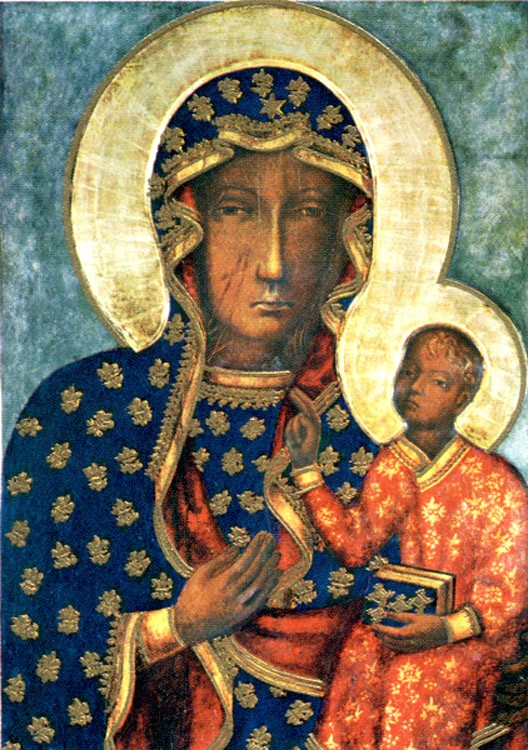
Our Lady of Czestochowa

As a busy mother (yes, I know that's redundant), I'm always looking for quick ways to reconsecrate myself to Our Lord and Our Lady throughout the day.  Otherwise, it's going to be a quick trip to H-E-double-hockey sticks for me!

Here's a wonderful little prayer I encourage you to pray each day to Our Lady of Czestochowa (pronounced chess-ta-HOV-ah, with the penultimate syllable stressed), courtesy of the National Shrine of Our Lady of Czestochowa in Doylestown, PA:

Holy Mother of Czestochowa, Thou art full of grace, goodness, and mercy.  I consecrate to Thee all my thoughts, words, and actions, my soul and body.  I beseech Thy blessings and especially prayers for my salvation.  Today, I consecrate myself to Thee, Good Mother, totally, with body and soul, amid joy and sufferings, to obtain for myself and others Thy blessings on this earth and eternal life in Heaven.  Amen.


While you're at it, you can offer up this prayer not only for yourself and your family, but also for the cause for canonization of Blessed Pope John Paul II, a native Pole and strong devotee of Our Lady of Czestochowa, the patron saint of Poland.


March 19, 2012

It Ad Joseph (Go To Joseph!)

St. Patrick's Day was a high feast day around our house this weekend!  We practically painted the house and everything in it shamrock green!  Even one of our former parish's priests wore a stole bearing the colors of the Irish flag.  Do you know what those colors represent?  The green represents the Catholics, the orange represents the Protestants, and the white represents the hoped-for peace between them.

(....yeah, I know.  Keep praying!)

Today, of course, good St. Joseph is not to be ignored.  For all you Italians out there -- or just you humble daughters of the foster father of our Lord -- here are some crafty ideas for celebrating this important feast day from one of the usual suspects, Catholic Icing.

Additionally, we found a really lovely, simple, paper "St. Joseph's Altar", courtesy of Evann Duplantier, for your family to construct.  Evann also has a lovely page full of menu choices, where you may enjoy everything from inspirational photos of other St. Joseph's Day altars to a super easy (and yummy!) edible craft.

St. Joseph's Altars may be as humble or elaborate as you like, but I encourage you to enjoy this lively Italian tradition in your home.  From red wine to seafood to donuts, it's worth consecrating your edibles to the man who was the Provider for the Holy Family.

Our parish deacon reminded us last Christmas that, although St. Joseph figures prominently in Jesus's early life in the Bible, St. Joseph never says a word.  Not one syllable.  How many of us could be counted upon to hear the Lord, follow His instructions, trust in His ways, and serve Him as He wishes, without ever saying a word?

Not me.

Yet St. Joseph gives us all the perfect example of "silent strength."  If you want to raise up a mentor for your spouse, a hero for your sons, a good example for your fathers, or a model husband for your daughters, "it ad Joseph."  Go To Joseph!

And that's an order straight from the top:

Blessed "Pope John XXIII, who succeeded Pius XII in 1958, added some new feasts and made some other changes to the liturgical calendar, as well as amending some of the rubrics. In his 1962 edition of the Missal, he also deleted the word 'perfidis' (Latin: 'faithless') from the Good Friday prayer for the Jews, and added the name of St. Joseph to the Canon of the Mass. The second change was particularly significant, as many had considered the text of the Canon to be practically untouchable." (emphasis added)

Prior to Vatican II, Eucharistic Prayer I was the only Canon used by the Church.  And it hadn't been touched for over 1,000 years.

Tales by the camp fire from that Council have it that an elderly priest originally made the humble suggestion to add St. Joseph to the Mass.  He was scoffed at by Vatican hierarchy, only to be vindicated when Pope John XXIII approved the addition the very next day.

It Ad Joseph!  And enjoy!


March 18, 2012

To Veil or Not To Veil?

Ever since the corrected wording of the Mass was restored at Advent last year, the thought of wearing a veil has been in my heart.  But I agree w/ so many -- when you're unaccustomed to seeing it, the wearer can seem ostentatious.  Then I saw a woman (admittedly, older) one day wearing a black veil that was just a whisper, just barely there.  It was a traditional mantilla, shoulder-length, but the black lace was so sheer (almost like organza), with only some dainty lace edging, that my heart leapt and I thought, "Ah-ha!  There is the veil for me!"

I happened upon her in the church parking lot during the week, and explained my admiration.  "Please tell me," I smiled, "where did you get it?"  She smiled back gently.  "I made it."

My heart sank.  Selfishly, my smile faded a bit.  "Oh," I replied weakly, hoping to sound as if I thought that was lovely, but knowing instead that I sounded disappointed.

"I'd be glad to make you one!" she rushed to assure me with a delighted grin.  My hopes rose anew.

"Really!?" I asked.  Then inspiration struck.  "Ooo!  I make rosary bracelets!  I'll make you one!"

So now, we have exchanged sacramentals and I wear the veil at every Mass.

A dear friend, who recently decided to veil, noted that at her son's First Communion, the presiding priest complimented the children on how dressed up they were, and invited them to dress and comport themselves as well every time they received Jesus in the Eucharist, because it was just that special.  My veil helps me remember that importance, and now wearing it seems as natural as genuflecting.  J
ust as I would not wear my pajamas to Mass, my veil is a visible reminder to me that I am on holy ground, and so should garb myself appropriately.

The Bible calls a woman's hair her glory, and my veil reminds me that I should humble myself in every aspect before the Lord.  Since wearing it, I must also report that at least half a dozen women have approached me cordially to inquire about it and consider it themselves.

I'm not posting this to be a veil-pusher, but just to encourage anyone else who might be considering wearing a veil for Mass and in the presence of the Blessed Sacrament.  Remember, you're not wearing it in submission to any man around you.  You're wearing it in submission to The Son of Man, The Creator Of The Universe.  How humbled we are in the presence of the Lord!

....plus, it's not a burka, for Pete's sake!  ;-D

March 16, 2012

St. Patrick's Day - Irish Soda Bread


Irish Soda Bread

Ingredients (bread):
3 c. flour
¾ tsp. salt
½ c. sugar
1 tsp. baking soda
2 tsp. baking powder
¼ tsp. cream of tartar
1/3 c. butter
1½ c. buttermilk
½ box raisins (optional)

Ingredients (glaze):
¼ c. 10x confectioners sugar
2-3 tbl. milk

Instructions:
§      Mix dry ingredients.  Cut in butter.  Add raisins and buttermilk.  Batter will be sticky.  Flour your hands and shape into a ball.  Knead 15 seconds on lightly floured surface.
§      Place on lightly greased baking sheet to flatten into  a 10” diameter disc.  Cut a deep cross in the top with a serated knife, saying, “God bless this family, in the name of the Father, and of the Son, and of the Holy Spirit.  Amen.”
§      Bake at 350o for 40-50 minutes.
§      Brush on glaze while warm.  Serve!

(from the “Building the Family Cookbook”, by Suzanne Fowler)


March 14, 2012

Happy Pi Day!

Today is Pi Day!  Celebrate the mathematical constant that is the ratio of a circle's circumference to it's diameter, approximately 3.14!  (The actual number goes on endlessly for infinity.)  Math proves the order of the universe God created.  Here's how we celebrated it, with chicken pot pie at dinner:


March 6, 2012

Rules for Our Home

Here's a little post for your refrigerator!  We formulated these rules based on the current state of lots of Lilliputians in the house.  ....believe me, sometimes the very first rule is the hardest!

May the Lord bless your home with His order and peace!

______________________________________________________


Rules for Our Home

1 - Always have a joyous grateful attitude, even when no one else is looking.  (Psalm 34:1)

2 - JOY:  Jesus first; Others next; Yourself last.  Wait your turn patiently and help others. (Mark 12:30-31)

3 - Always be honest and respectful.  Take good care of everything and everyone God has given us. (Luke 16:10, 2 Corinthians 8:21, I Timothy 3:4, Exodus 20:12, Ephesians 6:4)

4 - Always be kind in your words and actions.  Treat others as you would wish to be treated.  (Matthew 7:12)

5 - Always clean up your own mess. Play with one toy at a time and put things back where they belong.  (Numbers 1:50, Numbers 3:31, I Chronicles 9:29, John 2:19)

6 - Always wonder.  Explore, seek, and learn something new whenever you can.  (Luke 9:43)

7 - Always live a balanced life.  Think, learn, pray, work, play, and enjoy something every day.  (Eph. 5:10)

8 - Never raise a hand to hit nor throw things.  (Exodus 21:12)

9 - Never let the sun set on your wrath.  (Ephesians 4:26)

10 - Always say, “Goodnight, I love you!”


March 1, 2012

Blessings or Burdens?

"She felt he was a burden to her....We were a burden."
(Lee Harvey Oswald's brother, Robert Oswald, in 1993, commenting on their mother's attitude toward her children)

It was late at night and we were watching a t.v. special on the Kennedy assasination, with interviews and photos of the never-before-seen type.  On hearing Oswald's remark, my heart fell through my stomach like a cold fat rock plunging to the bottom of a murky pond.  Oh.  Oh.  Oh, how awful.  What an awful, awful, feeling to have from the person whose love for you is meant to be unconditional in this world.  The person who, as I remind my own children when pressing my case for hugging, tickling, or kissing privileges, helped God to make you.  The person whose title, "Mother," has inspired everything from epic poetry, to the naming of ships and airplanes, to the giddy grins of grown football players waving into the camera as they mouth, "Hi, Mom!" while dancing a jig in the end zone.

Oh.  How awful.

.....yet, do I convey that to my children?  That they are a burden to me?

One wouldn't think so.  We had hoped fervently for nine years to have children, before we finally woke up and adopted our first one.  Ready to begin a second arduous effort of paperwork and travel, we suddenly found ourselves pregnant with #2.  And then had four more successive bundles of joy thereafter.

Whooppee!

Yet, in an entirely unscientific survey, I quizzed my friends as I brought my now mobile and rambunctious kids to soccer one particularly harrowing afternoon.  "Please tell me you yell at your kids," I implored as my munchkins merrily sprinted off and I took a deep breath into the cold wind.  The first mom nearly gasped and said, "Oh, my goodness!  Are you kidding me?  Thank you so much!  You, too!?  We had such a horrible day today!  I feel terrible!"

Another friend with ten children actually snorted with suppressed laughter and readily admitted, "Yes.  And anyone who tells you they don't is lying."

Since misery loves company, it was comforting to know I wasn't the only mother alive who had gone off like a grenade at her kids.  The greater comfort, however, was in how remorseful each of us immediately felt, how instinctively we knew our behavior diminished our roles as mothers, regardless of how justified we were in wanting to strangle the offending offspring.

A wise priest and former Navy chaplain once gave me two assignments as penance in my confession:  1).  find an outlet for my anger management (whether it was daily workouts like his former aircraft carrier commander or the silence of prayer time alone), and; 2). find a babysitter to enable me to get away from the kids for one hour a week (you know, like they say on the aspirin bottle -- "take two and keep away from children").

The merits or misdirection of "me time" is a post for another day, but in this instance the effects of my anger and desire for time alone needed to be addressed.

The Bible clearly says:

"Behold, children are a gift of the Lord!  The fruit of the womb is a reward.  Like arrows in the hand of a warrior, so are the children of one’s youth.  How blessed is the man whose quiver is full of them; they will not be ashamed when they speak with their enemies in the gate."  (emphasis added) (Psalm 127:3-5)

"Children’s children are the crown of old men...." (Proverbs 17:6)

"For you formed my inward parts.  You knitted me together in my mother's womb.  I praise You, for I am fearfully and wonderfully made."  (Psalm 139:13)

"When a woman is giving birth, she has sorrow because her hour has come, but when she has delivered the baby, she no longer remembers the anguish, for joy that a human being has been born into the world."  (John 16:21)

"At that time the disciples came to Jesus, saying, 'Who is the greatest in the kingdom of heaven?' And calling to him a child, he put him in the midst of them and said, 'Truly, I say to you, unless you turn and become like children, you will never enter the kingdom of heaven.' " (Matthew 18:1-3)

“See that you do not despise one of these little ones. For I tell you that in heaven their angels always see the face of my Father who is in heaven."  (Matthew 18:10)

 (....okay, do I need to keep quoting here?)

And yet, despite the Word of God, the world teaches us differently:
 
"I've got two daughters.  Nine years old and six years old.  I am going to teach them first of all about values and morals.  But if they make a mistake, I don't want them punished with a baby."  (Barack Obama, Town Hall Meeting, Johnstown, PA, March 29, 2008)

Which do I convey to my children?  That they are a punishment?  A burden?  Or a blessing?  Will my children look back on their childhood with wistful smiles and fond memories of warmth and love and laughter?  Or will they cringe and attempt to shake it off, suppressing memories of brusque impatience and yelling to get through the day, just glad they are past that as they try to move forward with their lives, beyond the ill effects of my influence on their early childhood?

Don't get me wrong -- I'm not suggesting I attempt never to yell at my kids again.  In a house with as much activity as ours, sometimes it's literally the only way to be heard.  And my husband is a huge advocate of the "ATM" method of discipline ("Ask 'em.  Tell 'em.  Make 'em."), which sometimes necessitates a raised eyebrow, a raised voice, and a raised hand pointing the way to the directed task.

But, the words of Lee Harvey Oswald's brother were heavy in my ears, his voice strong and steady as he nodded firmly, almost emotionless and matter-of-fact:

"I don't know at what age Mother verbalized the effect that she felt he [Lee Harvey Oswald] was a burden to her. But she certainly conveyed it to John and I at very early ages. We're talking seven, eight, nine, 10 years old. At what age Lee started gathering this, or sensing it, or hearing it and applying it to him, I don't know. But certainly by age three, he had the sense, 'I need to be someplace else.' Mother would be putting him with a nanny, or a babysitter, or in an orphan home with us, just to get us out of her hair. We were a burden."

Out of her hair?  Why?  What else did she need to go do instead?  What possibly could be more important than the formation of an innocent soul entrusted to your care?  We all have many other responsibilities, too, but as mothers we have first and foremost a primary priority: the raising of our children.

Do I consider my children to be a burden or a blessing?  Without question, I consider them a blessing!  But, is that what I show them day to day?  Do I hug, kiss, smile at, encourage, listen to patiently, pray with, and appreciate their presence in my life?  Or do I relegate their presence to another set of must/needs on my endless home and homeschool "To Do" lists each day -- snarling when we fall behind, growling when we fall short of perfection, and seething when they get side-tracked and fail to see the big picture of what we must accomplish that day?

I'm not Pollyanna and I don't envision successfully comporting myself with the practical perfection of Mary Poppins any time soon.  But, I am honest enough to recognize that I need to step back and regain some of the perspective I had as an individual in the Lord's presence before all The Wee Folk arrived.  In the words of Venerable Bede Jarrett, O.P., we have no abiding city here, but our actions will bear out our eternity.

And as mothers, we also are training (for good or for ill) other impressionable souls.

"But if anyone causes one of these little ones who believe in me to sin, it would be better for him to have a large millstone hung around his neck and to be drowned in the depths of the sea." (Matthew 18:6)

"Preach the Gospel always.  When necessary, use words." (St. Francis of Assisi)

"Children Learn What They Live" (by Dorothy Law Nolte) 

Am I teaching my children, by my example, to be know-it-alls, love the things of this world, and be self-serving?  Or am I teaching them to know, love, and serve Him in this world and be happy with Him forever in the next?

A wise friend once said, "the years fly by, but each day is an eternity."  Maybe God sometimes lets our days seemingly drag out so that we have as much time as possible to mend our ways, to turn to Him, and to train our children to do so, too.  At this point in my life, I now know mothers whose children have pre-deceased them.  From miscarriages to suicidal teenagers to cancer-striken adults, "How tragic!" doesn't begin to describe the pain these mothers endure.  Any one of them would give her right arm for just one more day with her child.

Will I ever appreciate the presence of my own children as much?

I'm not touting impossible motherly perfection.  And it's going to take more than one well-meaning Lent to amend my short fuse, change my habit of sharp anger, grow in Godly patience (actually, 21 days, I'm told), and be the mother I want my children to have.

It's going to take one step at a time.  One small step at a time.  But, I'm going to start now.  Start today.  And start small.  You know -- a trip to the Perpetual Adoration Chapel, two aspirin, and a hope to at least attain mediumcalifragilisticexpialidocious.

I'll keep you posted in 21 days.

"There was never a child so lovely but his mother was glad to get him to sleep."  (Ralph Waldo Emerson)

A happy childhood lasts a lifetime!


Children Learn What They Live

by Dorothy Law Nolte, Ph.D. - 1972
 
If children live with criticism, they learn to condemn.
If children live with hostility, they learn to fight.
If children live with fear, they learn to be apprehensive.
If children live with pity, they learn to feel sorry for themselves.
If children live with ridicule, they learn to feel shy.
If children live with jealousy, they learn to feel envy.
If children live with shame, they learn to feel guilty.
If children live with encouragement, they learn confidence.
If children live with tolerance, they learn patience.
If children live with praise, they learn appreciation.
If children live with acceptance, they learn to love.
If children live with approval, they learn to like themselves.
If children live with recognition, they learn it is good to have a goal.
If children live with sharing, they learn generosity.
If children live with honesty, they learn truthfulness.
If children live with fairness, they learn justice.
If children live with kindness and consideration, they learn respect.
If children live with security, they learn to have faith in themselves and in those about them.
If children live with friendliness, they learn the world is a nice place in which to live.